The Exposome

Here is a concept, born out of experimental epidemiology, that may have profound influence on how we, as landscape architects, appreciate the influence of the environment and the places we design as having perceptible impacts on people’s health.
The Exposome is an emerging term, coined by C. WIld in 2005, that can be described as the environmental equivalent of the genome. The Exposome is everything the body is “exposed” to - cradle to grave - from air, water, toxins, food, relationships, cities, events, etc. It is a fascinating concept, it is vast, incalculable but at the same time arguably the greatest influence on our health and wellbeing we know of.
Historically much emphasis has been placed on biology and genetics when understanding disease and health. With the sequencing of the human genome (finished in 2001), medical science’s attention has been focused on their new ‘toy’; the wealth of information that is our genes. Most research was and still is focused on therapeutics and treatments that target genetic diseases.What a genetic heavy understanding of health leads to is potentially an overemphasis on the individual as an isolated biological entity as if we were looking at someone's health in the confines of a lab.
Instead, when we look at an individual’s health through the lense of not just genetics but also the Exposome we come to understand that health and disease is much more complicated than isolating a particular gene or pathogen. We exist in an infinitely complex world of ‘exposures’, be they Big Macs, clean water, chairs, gym machines, mothers, dogs, salads and fuel exhausts. And though we do have knowledge on how some of these exposures influence our health specifically, the overlaid complexity of these means that we ultimately need to take a holistic approach to understanding health, the world and how we exist within it.
I see a lot of similarities between the theoretical understanding of the Exposome and Object Oriented Ontology (OOO). In general there is an understanding and an embracing of the individual not as sovereign, but one that is awash with the shadows of countless entities all meshing together in what we collectively call ‘existence’. I am attracted to the idea of the Exposome because it once again places the individual back into a rich, pulsing and messy world, we’re we are exchanging information across partially permeable membranes with other organisms and objects. Furthermore an Exposomal understanding of the world is similar to OOO in the way that it is ontologically flat. Much of the work that I’ve read does not presuppose that one particular “exposure” is of more importance than another in understanding the health of an individual. It casts it net wide to include everything that one is exposed to in one’s life be they tangible or intangible. Of course, through the scientific process and on any given experiment, the researchers will eventually get specific on particular exposures, but the general principle stands in the beginning that almost anything can be considered an influence in understanding the health of people.
So how does all this mesh together? How does the individual exist in a world banging into other objects that eventually lead to positive or negative responses in our bodies? My hack-kneed understanding of this is there are three things at play. There is the environment, epigenetics and then genetics.
The environment, or synonymously the Exposome, is understood to be everything beyond the individual. Genetics, obviously, is within the individual and is recognised as the ‘code’ of life. Finally, epigenetics is more difficult to place, is it within the body or beyond it? In a way epigenetics is located in neither, it is a go-between. As epigenetics is understanding of how the environment influences the expression of genes I see it as the fundamental threshold between two ontological entities, the person in question and the environment they inhabit. Epigenetics may be thought of as the medium of exchange from the ‘outside’ to the ‘inside’
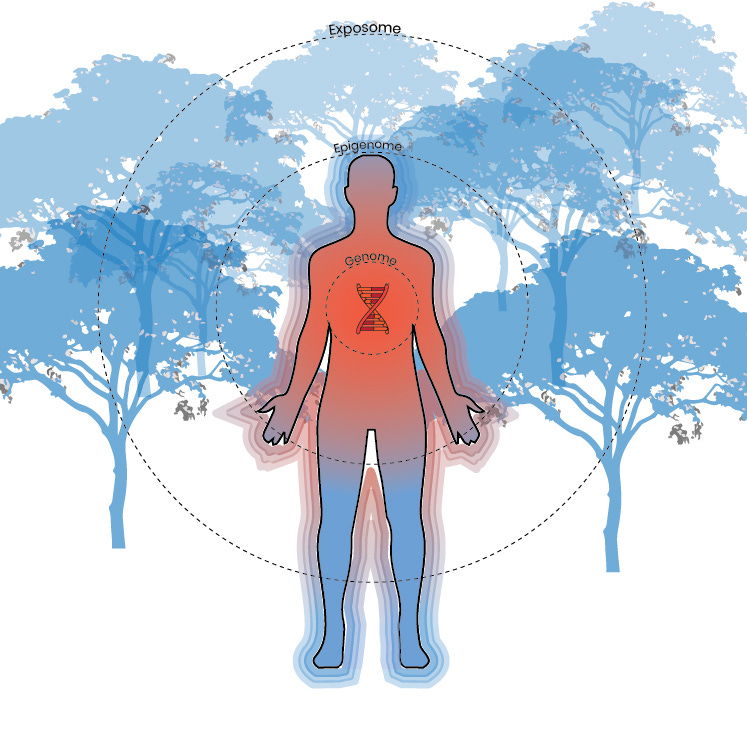
This was a lightbulb moment for me. Growing up twenty years ago, my highschool education in science taught me that genetics and pathologies were much more fixed. Off the cuff phrases like “winning the genetic lottery”, inferred that you just get on and live with the genetic hand you were dealt. Genetics seemed solid and unmovable, in part because epigenetics and the Exposome had not filtered down into schooling. Now, with this triple layered understanding of the Exposome, epigenetics and genetics, I can see how we are completely and utterly exposed to the influence of the environment around us. It is not some wishy washy desire to live somewhere ‘nice’ but it is absolutely imperative that we strive for a living in a good environment as we are developing a specific, measurable and scientific understanding on how the exposome affects our health, happiness and genetic development.

If I think for a minute, through the lens of the Exposome, what environments or landscapes would I want to be ‘exposed’ to? If I am but a sieve, exchanging positive or negative information with my environment and it subsequently being encoded in mine and my future offspring’s genes, where should I place myself? I immediately think of places that are more ‘natural’. Places with good dirt, where you can smell entropy and the cycles of life. I also think of the damage I’ve potentially done, living most of my life in crowded, polluted cities, sucking down car exhaust while riding my bike to work.
So then how do landscape architects fit into this puzzle? Well, we are deeply invested in one of the three spheres, the environment. As designers of environments, in particular landscapes and open spaces, the idea that through our projects we are directly affecting the expression of peoples genes and their resiliency or susceptibility to disease is exhilarating! The fact that through what we put down on paper and is eventually built, the exposures we curate in landscape can potentially poison or purify users, be they animals, plants or people. Researchers studying the Exposome not only look at material influences on the body, be they toxins, nutrients, but they also factor in more intangible influences such as relationships, climate, family history and culture. In this way they are similar to landscape architects in their holistic understanding of how people either flourish or perish in their environment. As landscape architects we have great influence over these elements that eventually become our Exposome. We are designing the Exposome not just for it to look pretty, to win awards or to save the planet from the carbon apocalypse but we are also designing it to protect future generations health through the epigenetic dance of people and place.